
What Happens to Your Money When a Sister Site Shuts Down
When a casino brand closes, the important questions are not only where the players go next. They are who holds the money, what the licence holder must communicate and how withdrawals will be handled.
What happens to your money when a casino closes?
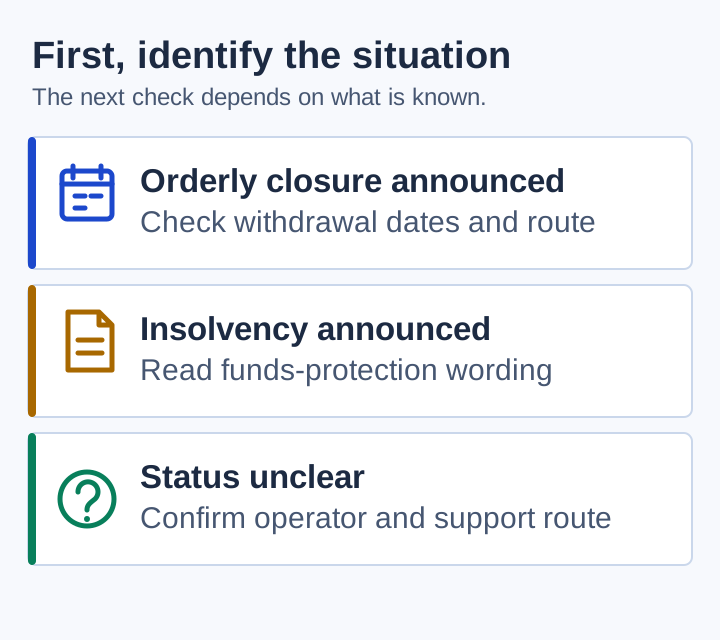
If a sister site shuts down, your next step depends on the type of closure. A planned brand closure is different from insolvency, a licence surrender, a market exit or a temporary suspension. In an orderly closure, the operator should tell customers what is happening, stop taking new registrations at the right time, explain how remaining balances will be returned and give a route for unresolved withdrawals or complaints.
If the business becomes insolvent, the situation is more serious. The Gambling Commission explains that money held with a gambling business is not protected in the same way as a personal bank account. Remote operators must keep customer funds in a separate account, but that separation does not guarantee every customer will get all money back if the business has financial trouble. That is why the customer-funds protection wording is important before you deposit, not only after a closure notice appears.
Sister-site research matters because a closed brand may sit inside a wider network. The operator may move customers to another brand, point them to a related site, close only one logo while keeping the platform running, or exit a market entirely. Players should not assume that another sister site automatically inherits balances, bonuses or complaints. The legal entity and closure notice decide the next step.
First, identify the type of closure
A shutdown can mean several things. A casino may retire a brand but keep the operating company active. It may leave the UK market while continuing elsewhere. It may merge players into another brand. It may stop accepting new registrations while paying out existing balances. It may lose, surrender or vary a licence. It may become insolvent. Each version creates a different risk profile.
The closure notice should tell you what is happening. Look for the closure date, final deposit date, final wagering date, withdrawal deadline, support email, complaints route and whether outstanding bets or bonuses are affected. If the notice is vague, contact support immediately and keep a copy of the page. Do not rely only on social media posts or third-party summaries.
A planned closure should feel orderly. There should be a date, a clear message to customers and instructions for balances. A sudden or confusing closure needs more caution. If the website is unavailable, check your email, payment records, the operator's other brands and the regulator's licence information. The goal is to find the legal entity responsible for your balance.
If a sister site remains open, do not assume support staff there can resolve the closed brand's balance. They may share a group, but customer funds and account contracts may still sit with a specific licence holder. Ask which company holds your account and which complaints process applies.
What happens to deposited funds and winnings?
Deposited funds and cash winnings should be treated differently from bonus credits. Deposited money is the player's own money. Cash winnings that have been cleared and credited are usually part of the customer balance. Bonus funds, free spins, pending promotional wins and loyalty credits can be subject to separate terms, especially where wagering is incomplete or the offer has expired.
When a brand closes, check whether the operator has set a withdrawal deadline. Some closures give customers a window to log in and withdraw. Others ask customers to contact support. If the site is still accessible, request your withdrawal early and save confirmation. Waiting until the final day creates avoidable risk if documents, payment method issues or support delays appear.
KYC can still apply. A closure does not remove the operator's obligation to verify identity, payment ownership or source-of-funds information where required. If your balance is large or your account has not been verified, expect document requests. Submit documents through official channels only and keep records of upload confirmations or support replies.
If a payment method is no longer available, ask the operator how funds will be returned. Return-to-source rules can complicate withdrawals when a card expires, a bank account closes or an e-wallet changes. The casino should explain the alternative process, but you may need to provide extra proof that the replacement method belongs to you.
Customer-funds protection in plain English
UK-facing gambling businesses must tell customers what level of protection applies to their funds if the business becomes insolvent. The Gambling Commission describes three broad customer-funds protection levels: not protected, medium protection and high protection. The label matters because it tells you what could happen if the business fails.
A key point is that separate customer-funds accounts are not the same as a bank-style guarantee. The Commission's public guidance says gambling balances are not protected by the Commission or government in the way personal bank accounts are protected. Online operators licensed by the Commission must keep customer funds in a separate account, but that does not guarantee repayment if the business runs into financial difficulty.
This is why closure content should not simply say "your money is safe" unless the operator's own customer-funds wording supports that statement. A player needs to know the protection level, the licence holder and the withdrawal route. A sister-site page should send readers to those details when a brand closure happens.
From 31 October 2025, Commission guidance also reflects stronger transparency around customer-funds disclosures, including reminders where funds are not protected in the event of insolvency. For players, the practical lesson is simple: check the customer-funds section before depositing and again if a closure notice appears.
Why the licence holder matters
The brand name is not always the company that holds the gambling licence. A casino may be a brand operated by a larger licence holder, a white-label arrangement or part of a wider group. When a site closes, the licence holder is often the key to understanding who is responsible for customer communications, withdrawals, complaints and regulatory obligations.
Look for the licence statement in the footer. UK-facing remote operators should display licensed status information in a way that links to current Gambling Commission records. Check the account number, company name and any trading name. If the brand has disappeared, search your emails and old terms for the legal name.
Do not assume a sister site is responsible just because it looks similar or belongs to the same network page. A related brand may be operated by the same company, but your account agreement may still name the closed brand or a specific licence holder. If you contact a sister site, ask them to confirm whether they can handle the closed account or whether a separate support address is responsible.
The licence holder also matters for complaints. If you need to escalate, you need the right company, the right complaint route and the right alternative dispute resolution information where applicable. A network page can help you identify the operator trail, but the closure notice and current terms should still be your primary sources.
Orderly closure versus insolvency
An orderly closure is the cleaner scenario. The business may be retiring a brand, consolidating customers or leaving a market without being insolvent. In that case, the operator should plan communications, stop registrations, settle bets where relevant, return customer funds and explain what happens after the website is no longer active.
The Gambling Commission has reminded licensees leaving the market that an orderly closure plan should cover customer communication, dates, active customers, customer funds and how funds will be returned even after a website is no longer active. That gives players a useful checklist for judging the quality of a closure notice.
Insolvency is different. If the business cannot meet its obligations, customer-funds protection becomes central. The fact that money is held separately may improve the situation, but it does not guarantee full recovery. The customer-funds protection level disclosed in the terms becomes highly relevant.
Players should respond differently in each case. In an orderly closure, follow the withdrawal instructions quickly and keep records. In a possible insolvency, gather account evidence, balance screenshots, payment records and communications. If the website stops working, those records may become the only proof you have readily available.
Shutdown checklist
Use this table as soon as you see a closure message.
| Check | What to look for | Why it matters |
|---|---|---|
| Closure date | Final date for deposits, play, withdrawals and support access. | Missing a deadline can make recovery slower. |
| Licence holder | Company name, account number and regulator link. | Shows who is responsible for the account and complaint route. |
| Customer funds | Protection level and insolvency wording in the terms. | Explains how exposed balances may be if the business fails. |
| Balance type | Deposits, cash winnings, bonus funds and pending rewards. | Different balances may have different treatment. |
| Withdrawal method | Return-to-source rules and alternatives if the old method is unavailable. | Payment problems often appear during closure windows. |
| Support route | Email, phone, chat, complaint form and deadlines. | You need a dated paper trail if support is delayed. |
What about bonuses when a site closes?
Bonuses are usually less secure than cash balances because they depend on promotion terms. If a site closes while you have an active bonus, check whether wagering can still be completed, whether the bonus will expire, whether promotional play stops before cash play and whether any bonus winnings will be converted or removed.
Some operators may cancel unfinished promotions as part of a closure. Others may allow a final play period. Some may convert certain balances, but you should not assume that. The answer should appear in the closure notice, promotion terms or support response. If it does not, ask before continuing to play.
For sister-site players, the important point is that bonuses do not automatically transfer. A related brand may offer a new promotion, but previous-customer or related-brand rules may still apply. If the old site closes and a sister site opens its doors to former customers, check whether the offer is genuinely available to migrated players or only to new customers with no group history.
A closure can also affect wagering strategy. If time is short, trying to complete a bonus can encourage rushed play. That is risky and can be harmful. If a bonus deadline creates pressure, consider abandoning the bonus and focusing on withdrawing real-money funds where possible.
If customers are moved to a sister site
Sometimes a closure message points customers toward another brand in the same group. That can be convenient, but it should not be treated as automatic consent to new terms. Read what is being transferred. Is the account transferred, or are you being invited to register again? Is the balance moved, or must you withdraw from the closing site first? Are marketing permissions carried over? Are bonus rights preserved?
If a balance transfer is offered, check whether KYC must be repeated. Also check whether the new brand has different withdrawal limits, payment methods, country restrictions or safer-gambling tools. A sister site may share an operator while still using different front-end terms. Do not assume identical rules.
If you are invited to open a new account, check bonus eligibility. A player moved from a closing brand may not count as a new customer for a sister-site welcome offer. The migration page should make that clear, but promotion pages are not always written with closures in mind. Ask support if the wording is ambiguous.
Also check safer-gambling controls. If you had limits, time-outs or exclusions on the closing site, those controls should not be ignored simply because another brand is available. Ask how the new site handles existing limits before logging in or depositing.
How to protect yourself before any closure happens
The best time to understand customer-funds protection is before you deposit. Open the terms and search for "customer funds", "insolvency", "protection" and "segregated". The wording should tell you what level of protection applies. If you cannot find it, ask support before holding a large balance.
Keep balances sensible. Casino accounts are not savings accounts. Leaving a large unused balance at a gambling site creates unnecessary exposure, especially if the customer-funds protection level is low. Withdraw money you are not planning to use for gambling and keep your own records of deposits and withdrawals.
Verify your account early. If documents are required, it is better to discover that during normal service than during a closure window. A last-minute KYC request can slow withdrawals, especially if support is busy with many customers asking the same questions.
Use network research to understand concentration risk. If you hold balances across several sister sites, they may depend on the same operating company. That does not mean they will all close together, but it does mean the operator trail matters. A network hub can help you avoid treating several related accounts as completely separate exposure.
What to do if the website is already gone
If the website is no longer accessible, start with your email inbox. Search for the brand name, operator name, deposit confirmations, withdrawal confirmations and closure notices. Check spam folders too. A closure notice may include a support address that is still active after the gambling site disappears.
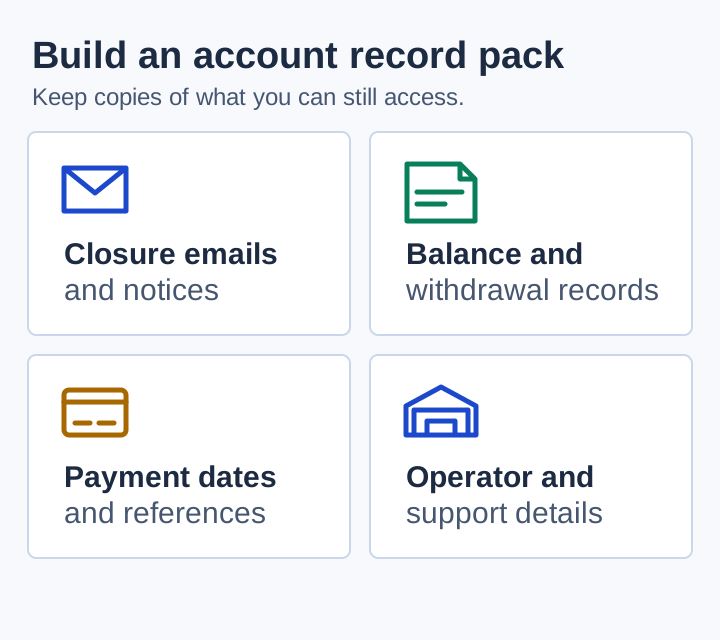
Next, gather payment records. Bank statements, card records, e-wallet history and crypto transaction records can help prove deposits and withdrawals. If you have screenshots of your balance, save them. If you do not, build a timeline from payment records and support emails.
Then identify the licence holder. Use old terms, archived emails, footer screenshots or the brand's network page. If a sister site is still open, contact support and ask for the correct route for closed-brand balances. Be precise: include your username, registered email, approximate balance, last login date and last transaction date.
If support does not respond, follow the complaints route associated with the licence holder where available. Keep messages short, dated and factual. Explain what happened, what balance you believe remains and what outcome you are requesting. Avoid opening new accounts in the same network while the balance issue is unresolved.
How sister-site closure content should be written
A good closure article should not panic readers, but it should not soften the risk either. It should explain the difference between an orderly closure and insolvency, point readers to customer-funds wording and make clear that a sister site does not automatically become responsible for every issue.
It should also track network context. If a closing brand belongs to a known operator group, readers need to know which related brands may remain active and whether account history, bonus eligibility or safer-gambling controls may follow them. That is especially important when a closure page encourages players to try another brand.
The article should avoid presenting replacement casinos as the main solution. The first solution is to recover balances, confirm withdrawal routes and understand account status. Only after that should a player consider whether another brand is appropriate.
That is the editorial difference Shufflebets is trying to make. Network pages are not just bonus funnels. They are a way to understand how brand relationships affect real player outcomes when something changes.
Sources and further reading
For official context, read the Gambling Commission guide on what happens to your money if a gambling business goes bust, the LCCP rule on segregation of customer funds, and the Commission reminder about licensees leaving the market. For brand relationships, start with the Networks hub.
Frequently asked questions
Will I lose my money if a sister site closes?
Not necessarily. In an orderly closure, the operator should explain withdrawals and balance returns. Insolvency is riskier, so customer-funds protection wording matters.
Are casino balances protected like bank savings?
No. Gambling balances are not protected in the same way as personal bank accounts. Check the operator's customer-funds protection level.
Can my balance move to a sister site?
Only if the operator offers that process and explains the terms. Do not assume balances, bonuses or account status transfer automatically.
What should I withdraw first?
Focus on real-money balances and cleared cash winnings. Bonus funds and promotional balances may be subject to separate terms.
What if support stops replying?
Gather records, identify the licence holder and use the official complaints route where available. Keep messages factual and dated.